AI marketing automation takes the repeating jobs in your marketing, like planning, drafting and posting, and does them from a plan you approve. It suits small teams because the routine eats the week. Strategy, tone and what is true about your business stay with you.
What is AI marketing automation, in plain words?
AI marketing automation means software does the repeating parts of your marketing, so your team can spend its time on the parts that need a human.
Picture a three-person shop. Monday morning, someone asks, "What are we posting this week?" Then comes the search for pictures, the writing, the posting on each platform, and the same again on Wednesday. It's not hard work. It's just never finished.
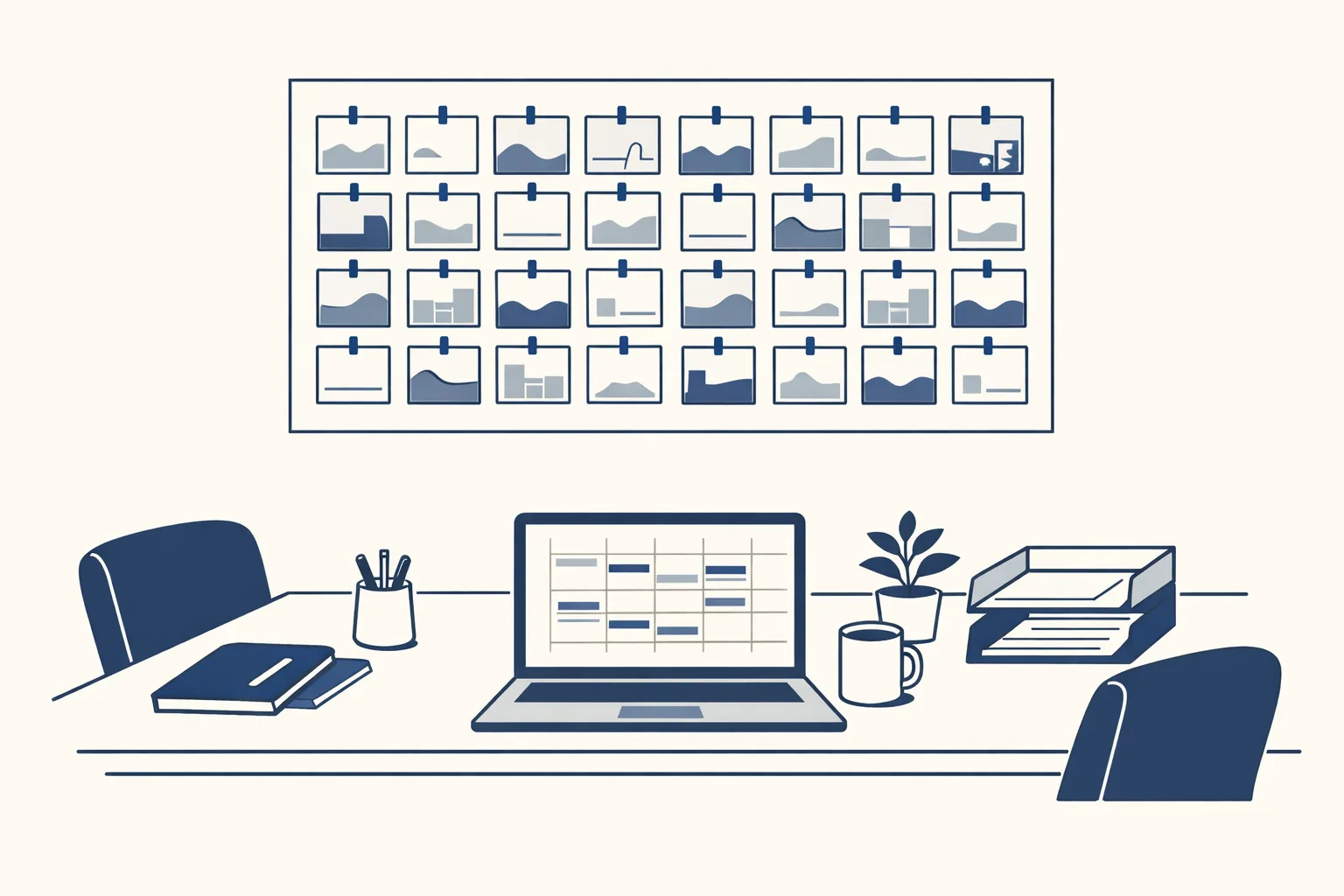
With AI marketing automation, the plan lives in a sheet. The drafts are written from it, the pictures are matched, and posts go out on the days you set. People still decide what to say. The machine does the carrying.
The honest limit: it doesn't know your business until you tell it. The first weeks are about teaching it your tone, your products and your rules. After that, each month gets easier.
It's different from the old kind of marketing automation, which mostly sent the same email to a long list. This kind writes new, fitting drafts from your own material.
What can a small team hand over?
The jobs that look the same every week are the ones to hand over first.
A small online shop might spend half a day each week on the same loop: think of ideas, write captions, find pictures, schedule posts. That loop is a good fit. The list below shows what we mean.
Notice that the plan comes first. Automation can't fix a month with no idea what to say. It only carries out a good plan faster. So the first hour goes on the calendar, not on the tool.
Good candidates for automation:
- A monthly content calendar kept in one sheet, one row per post.
- Draft posts written in your tone from that calendar.
- Pictures and short vertical videos in one house style, with captions and an end card.
- Publishing on the days and platforms you chose.
- A short look-back at what went out, so you can decide what to repeat.
- Reminders for dates that matter, like seasons, sales and anniversaries.
What should stay with people?
Anything that depends on judgment, trust or fresh ideas should stay with people.
A small restaurant that gets a bad review should answer it personally. A bakery that wants to try a bold new campaign needs a human to decide whether it feels right. A tool can draft options, but it can't know how your regulars would take a joke.
A good test is simple: if a wrong word could cost you a customer or a refund, a person writes or checks it. If a wrong word only means a slightly dull post, a draft is fine.
Also keep these with you:
- What is true: prices, offers, opening hours, claims about your products.
- Replies to customer comments and messages.
- Sensitive topics and anything legal or medical.
- The big ideas and the choice of what the business stands for.
- Paid ads. We don't run them.
How many hours does your routine posting take?
Type in your own numbers. The result is the time you spend on routine posts today, by your own count. It is not a promise of what automation would save.
How do you start in a small team?
Start with one routine, one platform and one person who checks it.
Say a team of four wants to stop the Monday scramble. They pick LinkedIn only, one post a day on working days, and one person to read drafts for ten minutes each morning. After a month they know what works. Then they add a second routine.
Keep the first month small on purpose. A team that tries to automate five things at once ends up fixing five things at once. One routine, done well, builds the trust you need before you add the next.
Here is a simple path:
- Pick the one marketing routine that eats the most time.
- Count the minutes it takes now. The calculator below helps.
- Write the rules: tone, topics, things never to say, who approves.
- Build a calendar for the next month in a sheet.
- Let drafts be prepared and read them every day for two weeks.
- Keep what works, fix what doesn't, then add a second routine.
A normal week, by hand and with automation
The difference shows in the week, not in a feature list.
By hand, the week has a scramble on Monday, a missed day on Wednesday and a rush on Friday. With automation, the calendar is ready, the drafts are waiting, and the person in charge spends ten minutes a day reading and fixing instead of two hours a day starting from nothing.
The saving is not magic. It is the hours you stop spending on starting from a blank page.
| Part of the week | By hand | With automation |
|---|---|---|
| Planning | A meeting that often slips | A calendar already in the sheet |
| Writing | Started from a blank page | A draft in your tone to fix |
| Pictures | Searched for each time | Matched to the post in a set style |
| Posting | Done one platform at a time | Done on the set day |
| Looking back | Rarely done | A short note on what went out |
Where do we fit?
On our own brand today, a posting robot publishes on LinkedIn on working days from an approved content calendar kept in a sheet. Short vertical videos are made from the same calendar. For your small team, the same set-up is built to order, and automated reports are built to order too.
Our own blog shows the idea at a bigger scale. Articles are written in three languages, each with a picture and a small interactive tool, and a robot publishes them from a master sheet on the dates set. The team's job is to decide the topics, not to push buttons.
Every step starts with your approval, then you choose when it goes automatic. Use the calculator below to see how many hours the routine takes you now.
Questions
What is AI marketing automation?
It's software doing the repeating parts of marketing, like planning, drafting and posting, from a plan you approve.
Is it only for big companies?
No. Small teams gain the most, because the routine eats a bigger share of their week.
Will my posts sound like everyone else's?
Not if the drafts are written from your own material and tone. You read each one and can change it.
Does it run paid ads?
No. We don't run paid ads. We build the plan, the posts and the short videos.
Where do I start?
Pick one platform and one routine. Count the minutes it takes now, then write down your tone and your rules.
Tell us your workflow. We will build it around you.
Tell us how many hours routine marketing takes in your team. Write to hello@thenewaiemployee.com and we'll say honestly what we could take over.
Talk to us Related service: Social media and video